Connection Is the Energy that Powers Performance
Thanks for registering. Add to your calendar.


Other option
This study set out to answer a simple question:
What happens when people feel connected at work, and what happens when they don’t?
Connection is the energy that powers performance. Like electricity in a building, you don’t see it directly. You see what it enables—people doing their work well, systems running smoothly, teams moving forward.
When that energy is strong, performance feels natural. When it weakens, everything becomes harder.
Most organizations treat connection as something to improve through programs, communication, or culture initiatives. But the data shows something different: Connection isn’t what happens after the work. It’s what makes the work possible.

The 2026 Human Connection Study combines:
Qualitative insight from more than 800 employees across the U.S.
Quantitative data from over 286,000 employees across nearly 1,700 organizations, in partnership with Energage
Together, these data sources show that connection is one of the strongest drivers of how people experience work.
Of those employees who report strong motivation, advocacy, and meaning in their work:
90%
feel motivated, find meaning, and advocate for their company vs. 15% of disconnected employees
82%
of employees with the lowest levels of connection have considered leaving in the past month
7x
more likely to recommend their company

Connection is the energy that powers performance.
Connection is the energy that powers performance. Like electricity in a building, you don't see it directly, you see what it enables.
People doing their work well.
Systems running smoothly.
Teams moving forward.
When energy is strong, performance feels natural. When it weakens, everything becomes harder.
Most organizations try to fix connection with programs, perks, or culture initiatives. But the data shows that connection isn't what happens after the work — it's what makes the work possible.
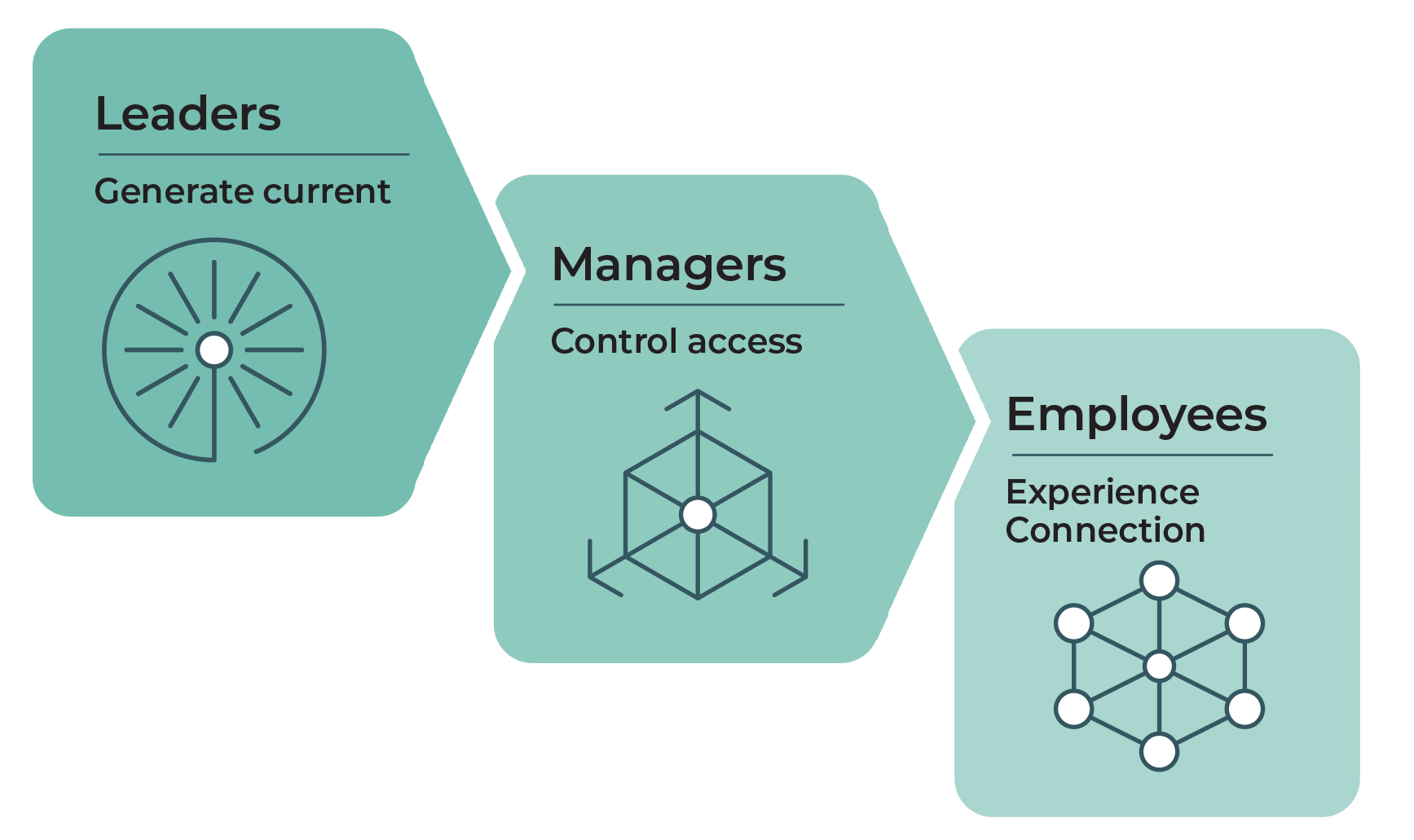
Connection is not built through perks, benefits, or compensation. It is shaped by whether people find meaning in their work, feel motivated to contribute, and have clarity on what matters.

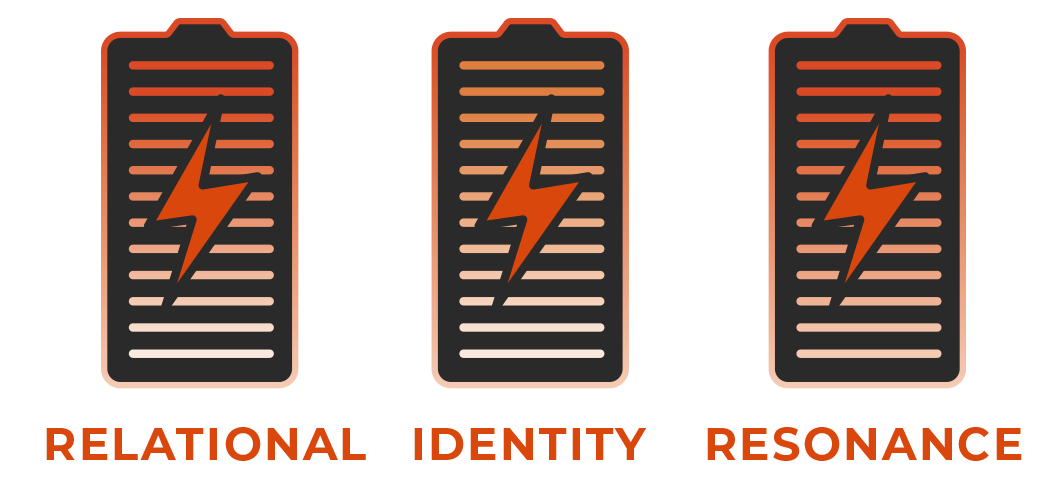
Connection isn't one thing.
It's three.
When employees describe moments of real connection at work, they don't talk about systems or programs. They talk about being heard. Contributing to something that matters. Feeling recognized. These experiences vary — but they follow a pattern. And before any of them can happen, one condition has to be in place.
The Foundation — Identity Congruence
It starts with one question:
Can I be myself here?
The most important enabler of connection is the degree to which a person feels they can be themselves at work. This isn't a soft cultural goal. It's the foundation everything else stands on.
When people can show up as themselves, connection comes more easily. When they can't, it becomes difficult — if not impossible.
1%
Just 1% of connected employees feel they can't be themselves at work. Among disconnected employees, that number is 60%.
The two ways connection shows up
Once the foundation is in place, connection appears in two distinct forms. Strong workplaces build both.
Resonance — Connection to Purpose
The experience that work has meaning and direction. It reflects whether employees understand how their work contributes — and whether they believe in where the organization is going. This is the strongest single driver of connection overall.
Relational — Connection to People
The experience of being seen, valued, and understood. It's built through everyday interactions — conversations, recognition, support. At its best, it answers a simple question: Do the people around me see me and care?
Only 58% of employees feel connected to their organization's direction. When this is strong, work feels energizing. When it's not, effort becomes mechanical.
A system, not a single lever
Strong connection tends to show up when employees can:
Be themselves
Have strong relationships with the people around them,
See how their work connects to a larger purpose.
When one of the three is missing, something feels off — like a system that's still running, but not at full power. That's why so many employees feel only partially connected. Not because connection is absent, but because it's incomplete.
Leaders create the infrastructure. Managers activate it.
For most employees, connection isn't shaped in town halls or HR programs. It's shaped in everyday interactions with one person — their direct manager.
75%
of how supported employees feel is explained by their connection to their manager.
No other factor — compensation, benefits, tools, or workplace design — comes close to this level of influence.
Managers shape relational connection by:
Listening
Responding
Recognizing effort
Creating space for openness
59%
of how employees experience growth and development is explained by the same connection.
Two Jobs, Not One
Managers are usually evaluated on one thing: results. But in practice, they're responsible for two things at once — driving results and creating the conditions that make those results possible. That second job is where connection lives.
Managers shape connection to purpose by:
Framing the work
Clarifying priorities
Connecting effort to impact
Communicating direction
Connection isn't evenly distributed — and the people doing the work are often the least connected to it.
Connection varies dramatically by role, environment, and access to the organization's direction. The pattern points to a hard truth: the employees most responsible for delivering the work are often the furthest from the experiences that build connection.
By environment
By role
Senior leaders report the highest levels of connection in the data — more than twice as high as front-line employees. They're closer to the decisions that shape direction. They don't just hear the strategy. They help define it.
By work environment
Employees working fully remote or hybrid report higher connection than those fully on-site. This doesn't mean remote work creates connection — it means connection is shaped by how work is experienced, not where it happens.
Where risk concentrates:
Front-line roles
Fully on-site
Lower visibility within
the organization
These employees are past onboarding but not yet deeply embedded. They carry responsibility, but have less access to visibility and direction than more senior roles.
Connection is shaped by access to direction, visibility, and meaningful context — not just role or work location.
What you'll find in the full study
-
The decisive role connection plays in motivation, advocacy, and retention.
-
The three elements: identity, relationships, and meaning.
-
The early signals that show up before performance drops.
-
Why managers, not programs, are the real catalysts.
-
The demographic and structural blind spots leaders miss.
-
The conditions that strengthen connection over time.
About the research
The Human Connection Study combines qualitative depth with large-scale quantitative validation to understand how connection is experienced — and what it produces. The goal: to equip leaders with the understanding needed to build environments where both people and performance thrive.
Phase 1 Qualitative
806 employed individuals
Demographically representative U.S. sample
Open-ended responses on connection and disconnection at work
Conducted June – August 2025
Used to develop the initial model of what connection is, how it works, and what enables or prevents it
Phase 2 Quantitative
286,379 respondents
1,692 organizations
Anonymized, non-attributed employee survey data via Energage
Used to test and validate the Phase 1 model against real workplace outcomes at scale
806
qualitative respondents
286,379
quantitative
respondents
1,692
organizations
About the partners
Created in collaboration

Energage
Energage is an HR technology company that helps organizations measure, shape, and showcase cultures where people and performance thrive. Its insights are grounded in more than 20 years of workplace culture research, drawn from tens of millions of employee surveys across over 80,000 organizations nationwide. Energage also powers the Top Workplaces employer recognition program. [Link: energage.com]

Ingenuity Design
Ingenuity Design is an employee experience agency that strengthens organizations from the inside out. For over 18 years, the firm has partnered with Fortune 1000 companies and high-growth organizations to design experiences that improve how employees connect, contribute, and perform. Grounded in insight and built for action, its work focuses on the moments that matter most — those that shape connection, purpose, and performance. [Link: ingenuitydesign.com]

Jason Lauritsen
Jason Lauritsen is the CEO of Connected Performance Group and an advisor to leaders who are tired of choosing between results and their people. A former corporate executive, he developed the Connected Performance System to help leaders fix the systems that drive performance by strengthening connection at work. Jason is the author of Unlocking High Performance and a keynote speaker known for pairing provocative insight with practical guidance leaders can use immediately. [Link: jasonlauritsen.com]
Stay in the know.
Share your email to receive updates about this project and its findings